
Obituary: Ted Turner
Flawed founder of Turner Classic Movies and CNN was a visionary genius

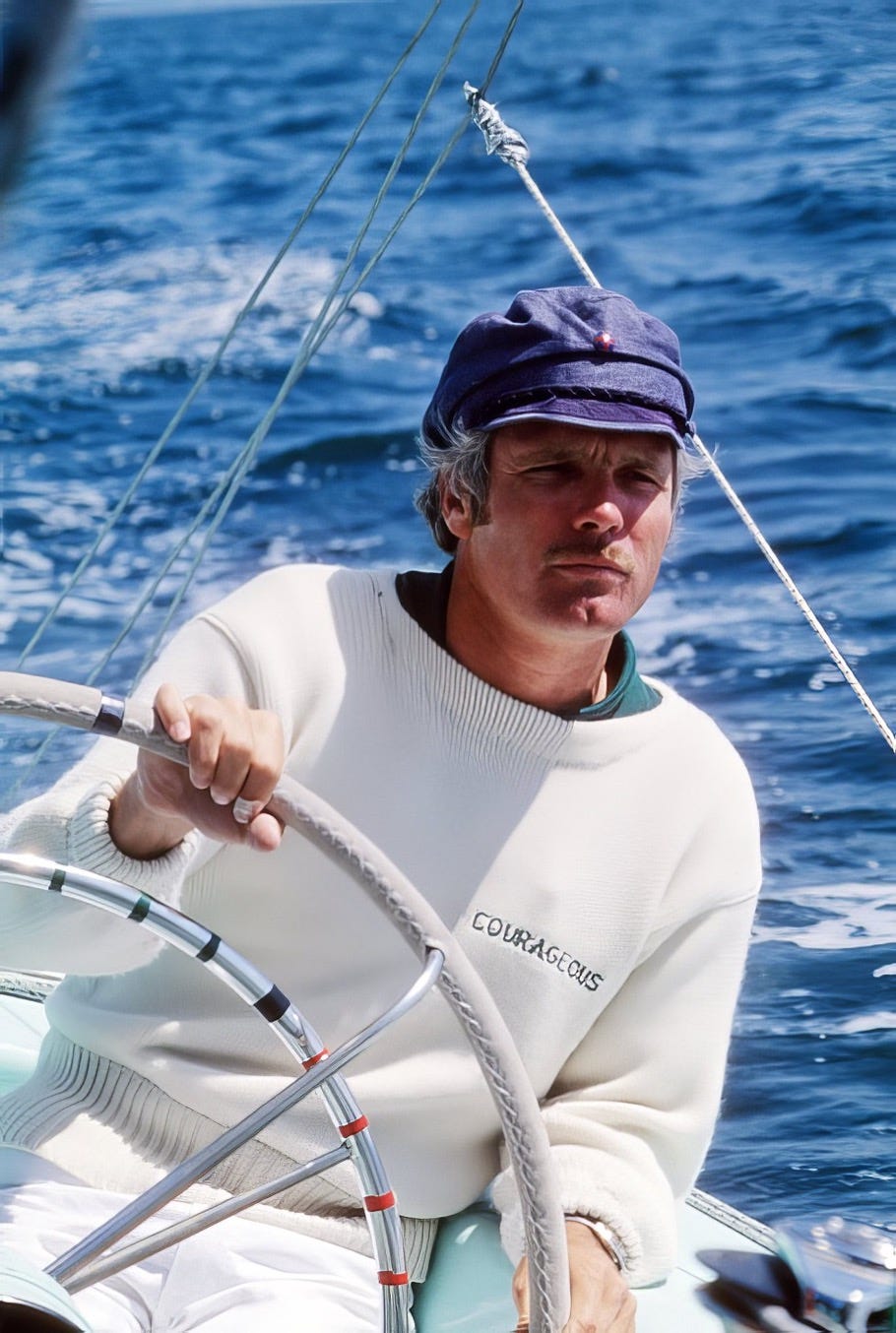
These are my thoughts on Ted Turner, whom I think was a great American media titan. Ted Turner was foremost a businessman who sought to profit. That he became a kind of universalist underscores what I think is Ted Turner’s tragic flaw; he was a dreamer who let dreams become his master, to paraphrase Kipling, which is why he stumbled in mergers and acquisitions time and again.
Ted Turner, who died this week, immersed himself in his visions to the exclusion of the facts of reality. In the business of today’s media industry in which he was a pioneer, his achievements are extraordinary. Ted Turner alternately weakened and strengthened America and the free press. He displayed glory and heroism while racing boats, sailing them across wild seas. celebrating America’s greatest sport, baseball, and one of the greatest movies ever made, David O. Selznik’s cinematic masterpiece based on Margaret Mitchell’s 1936 literary masterpiece of the same name. Gone With the Wind was the first movie to air on one of the many channels he created on Turner Classic Movies, which he named after himself—as American businessmen used to do—which I’ve had the pleasure to work with and cover for decades.
Turner was born in Cincinnati in 1938. His father, who owned a billboard company, whipped Ted Turner, who reportedly continued to defy his dad’s authority. Turner was 24 when his father, reportedly depressed and under influence of drugs and alcohol, shot himself dead, leaving the billboard business to his son. Suicide runs in the family of one of Turner’s wives, leftist activist and actress Jane Fonda, too.
After buying back property his dad had sold off, Turner started to build a broadcasting “superstation” WTBS (for Turner Broadcasting System) by running reruns of Bugs Bunny cartoons and shows such as Gilligan’s Island, Star Trek and I Love Lucy before acquiring the rights to the Atlanta Braves games in 1973. In 1986, according to the Hollywood Reporter:
Turner paid more than $1 billion for the film library of MGM/United Artists, which included Warner Bros. movies and Looney Tunes cartoons, and used his windfall of classic films to launch Turner Network Television (TNT) and Turner Classic Movies (TCM).”
I’ll add a personal note, which happened in the summer of 1980 when I was a teenage Republican invited to attend the Republican National Convention in Detroit. I boarded a bus to Michigan for the nomination of Ronald Reagan as the GOP’s candidate for President of the United States—a nation attacked and humiliated by Iran’s religious dictatorship, which Jimmy Carter had appeased time and again.
At that historic event, when I first walked into Cobo Hall, I looked up and noticed the big network media booths for the three major channels with which I had grown up—ABC News, CBS News and NBC News—however, for the first time in history, there was a fourth booth I’d never seen before. In curved red and white lettering, its acronym for its generic name, Cable News Network, hovered above the arena. I realized I was witnessing the birth of a new media age as well as a historic nomination of a candidate for the 40th American president. By 1991, CNN had scooped the three networks with the first live television reporting of a war.

Over the years, what Ted Turner created—whether CNN, TBS or outdoor billboards—continued to influence and make an impact on American culture. It began with his interest in the philosophy of egoism, capitalism and individual rights created by another historic American pioneer, Ayn Rand. Young Ted Turner, as a businessman in the South, had become interested in Rand’s philosophy, plastering Ayn Rand’s daring question from her 1957 literary masterpiece—“Who is John Galt?”—on billboards he owned throughout the South.
Ted Turner shamelessly pursued his own happiness, including making money, ever after. Eventually, he was reduced to propagating statism, altruism and collectivism. With a family history of mental illness, including clinical depression and alcoholism, he distorted reality and made terrible judgments, which badly hurt him and his media companies, tainting his legacy with strident and sometimes unhinged notions, including his environmentalist proposal for government control of parenting and a 2008 prediction of mass cannibalism due to “overpopulation”. Ted Turner’s visit to Communist Cuba and meeting with dictator Fidel Castro, friendship with Jimmy Carter and relationship with environmentalist Jacques Cousteau had fully converted him to leftist politics, including environmentalism, as he admits in his autobiography. By 1999, Turner, like Trump, was considering running for president.
But Ted Turner’s life and career is a lesson in thinking and dreaming big and holding to—and rejecting and veering away from—a systematic philosophy which guides your life. Turner’s achievements are worth remembering. In particular, classic movies—the movies—are rightly, widely revered thanks to what Ted Turner created.
The incessant, attention-deficit half-fragments of news reporting traces to CNN, unfortunately, which is forerunner to Fox News. Today’s predominant fake, warped or paltry news coverage began its dark descent into the anti-intellectual, sensorial hell with what CNN had quickly become: distorting facts, interrupting others and profiting from histrionics in fast-cutting, theatrical conflict instead of polite, rational, civil reporting, discourse and deliberation. Any episode of CNN’s Crossfire provides evidence. CNN worsened every year, every decade, until it finally merged with a company recently bought by another titan of industry who might turn it around.
CNN’s founder Ted Turner talked big and lived large. Though he was disturbed, his best legacy lies in the debut of Turner Classic Movies in 1994 when he dared to air the unmolested, four-hour original version of Gone With the Wind, introduced by the late Robert Osborne. This is an outstanding achievement, though, today, TCM risks going Woke, the way of CNN, becoming a bastion of leftist orthodoxy without a single voice of reason to champion what makes the movies possible—capitalism, liberty and promulgating that life can and ought to be as it is in classic movies.
Ted Turner’s life proves the good is possible. The ambitious businessman for profit and capitalism blazing through America’s new South—posing a question in black letters on a white billboard the world has yet to address, let alone answer—welcomed and promoted discourse, debate and exercise of free speech.
He revolutionized TV, sports, media, politics and the movies, if often for the worse. Who is John Galt? Ted Turner could have been had he stayed on course with a philosophy based on reason. He instead became a titan of industry and private property owner who briefly and in sporadic spurts embodied man as a hero before sabotaging himself into oblivion. But he made it easier to watch news, sports and uncensored classic movies without distraction.
If only, one of these great men of ability will truly understand the philosophy Ayn Rand imparts to them - what extraordinary things they could do for all of us.